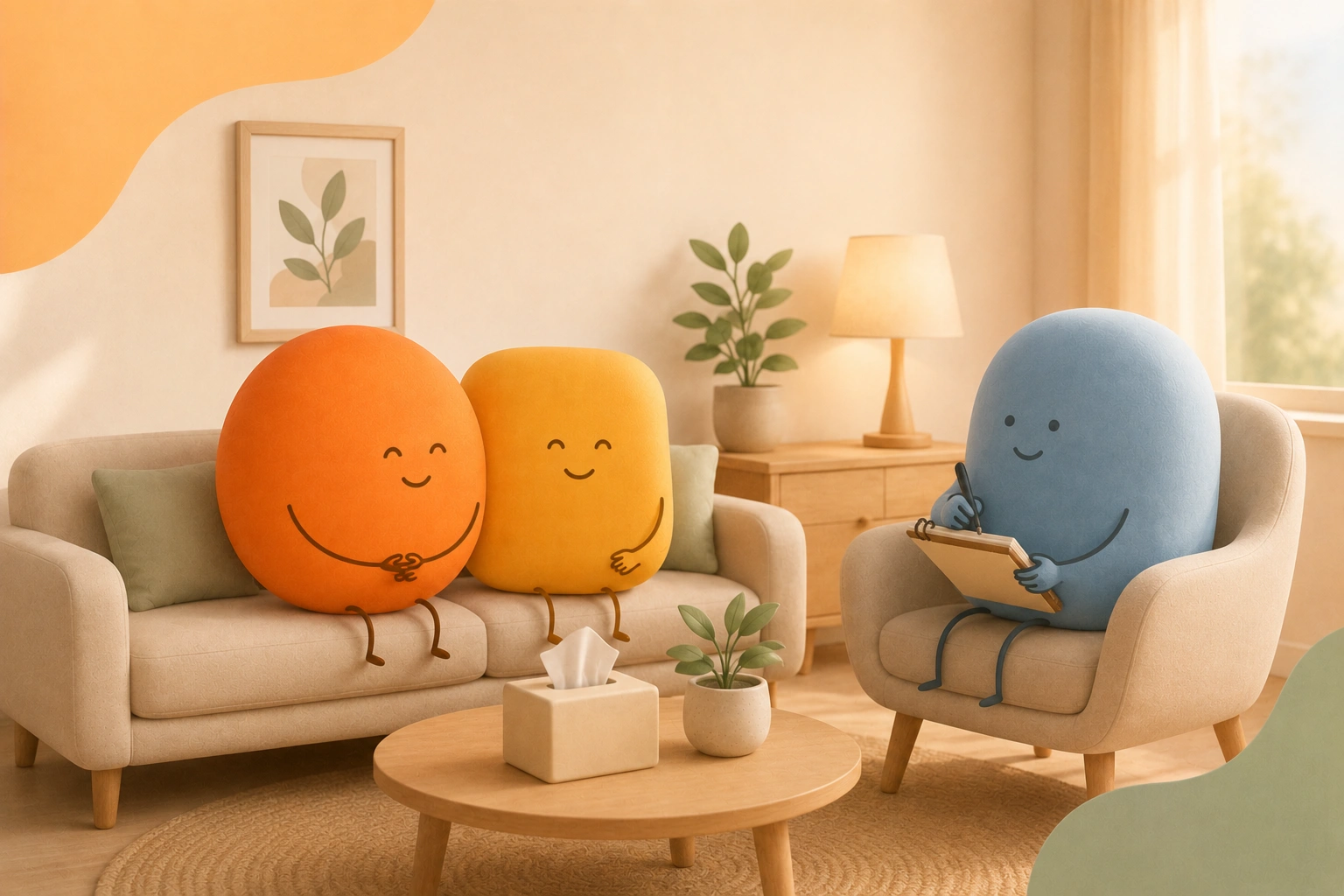
Here is the sentence that keeps couples out of therapy: "we're not that bad."
And it's true. Most couples considering therapy are not that bad. They are two tired people having the same argument on a loop, or living politely around a silence that has gotten comfortable, or carrying something, a betrayal, a grief, a move, that turned out heavier than expected.
Therapy was built for exactly that. The crisis version you are picturing, two people staring at the floor while a stranger referees the end of everything, is the rare case, not the typical Tuesday.
What couples therapy actually is
Strip the mystique and couples therapy is this: a trained third person who can see your pattern from outside it.
Every couple has a pattern. One pursues, one retreats. One floods, one freezes. One keeps score, one keeps quiet. From inside, the pattern just feels like "what my partner does." A good therapist's first job is to put the pattern on the table where both of you can look at it, often for the first time, as a thing you do together rather than a thing one of you is guilty of.
The patient in couples therapy is not you or your partner. It is the pattern.
That reframe alone, which usually lands in the first few sessions, is worth a lot of the fee.
What happens in the sessions
The first session is mostly story-gathering: how you met, what brought you in, what each of you wants. Therapists typically meet you together, sometimes once each alone, and there is no couch and nobody asks you to close your eyes. It feels like a structured, unusually honest conversation with someone who is impressively hard to shock.
After that, sessions depend on the approach. The two with the deepest research are Emotionally Focused Therapy, which works on the attachment level, the reaching and retreating underneath your arguments, and the Gottman Method, built from decades of observing real couples, which is more skills-forward: how you start hard conversations, how you repair, how you turn toward each other. We unpack both in our guide to marriage counseling, and the attachment ideas behind EFT in our attachment styles guide. If the word "therapy" itself feels like a lot, relationship counseling is the same help under a gentler name, and you don't have to be in crisis to go.
Either way, expect homework. Small assignments, a conversation to have, a ritual to try. The hour is the classroom; the week is the course.

Be one of the first couples in the nest
We're quietly making something small and warm for the two of you. Leave your email and you're one of our founding couples: first in when it opens, with a little thank-you we'll keep just for you.
No spam, no newsletter. One good email when it’s ready.
What it costs
Honest numbers, US: most couples therapists charge between 75 and 250 dollars a session, with the middle of the market around 100 to 150. Big cities run higher. Online sessions usually run lower. Community clinics and therapists-in-training offer sliding scales that can drop below 50, and they are often excellent.
Insurance is the annoying part: many plans only reimburse a diagnosis, and a tired marriage is not a billing code. Some couples get partial coverage when the work ties to anxiety or depression. It costs one phone call to find out, and one more to ask a therapist what they can do about it.
A useful frame for the sticker shock: a typical course of couples therapy, weekly for a few months and then tapering, costs roughly what a couple spends on a modest vacation. Few vacations are still paying out five years later.
Does it work?
For most couples, yes, and this is not a hopeful guess. Emotionally Focused Therapy has some of the strongest outcome research in the field, with most studied couples improving significantly and a large share recovering fully. The Gottman Institute publishes its own effectiveness research showing similar movement on relationship satisfaction.
Two honest caveats. Therapy works on couples where both people show up willing to look at their half of the pattern; it cannot out-argue someone who has already left in their head. And it works far better early. The famous finding that couples wait an average of six unhappy years before getting help explains most therapy "failures": the engine was driven on empty for too long. Which brings us to timing.
When it's time (you don't need a crisis)
Forget rock bottom. These quieter signs are the real referral slip:
- You have the same argument on rotation, and both of you could perform the other's lines.
- Something happened, an affair, a loss, a betrayal of trust, and it sits in the room during unrelated conversations.
- You have gone polite. No fights, no friction, no real contact. Roommates with a shared calendar.
- One of you keeps a tally the other one can feel.
- A big transition is coming, moving in, marriage, a baby, and you want to walk in with tools instead of luck.
- You tried the books and the talks, and the loop survived them.
Going to therapy early is not admitting the relationship is broken. It is refusing to wait until it is.
For your next conversation
- "If we could change one recurring argument with help, which would you pick?"
- "What would make the idea of therapy feel less heavy to you?"
- "What do you think our pattern is? I'll guess too."
However you decide, let it be a decision and not a default. The couples who do best are rarely the ones who needed therapy least.
They are the ones who went while there was still plenty left to protect.
What people ask before going
How much does couples therapy cost?
In the US, typically between 75 and 250 dollars per session, with most couples paying somewhere around 100 to 150. Online platforms often run cheaper, community clinics use sliding scales, and some employers' assistance programs cover a handful of sessions. Expect weekly sessions at first, spacing out as things improve.
Does insurance cover couples therapy?
Often not directly, because insurers reimburse diagnoses and "our marriage is tired" isn't one. Some plans cover it when sessions relate to a covered condition like depression or anxiety. Worth one call to ask, and worth asking therapists about sliding scales either way.
Does couples therapy actually work?
For most couples, yes, meaningfully. Approaches like Emotionally Focused Therapy and the Gottman Method have decades of outcome research showing most couples improve and a large share recover fully. The biggest predictor of success is starting before contempt and exhaustion set in.
Do we need to be in crisis to go?
No, and the couples who get the most from therapy are usually not in crisis. Think of it like a dental cleaning rather than a root canal: maintenance is cheaper, faster, and considerably less painful than rescue.
What if my partner refuses to go?
Go alone first; individual work on a relationship genuinely moves it. Then frame the invitation around the relationship, not their flaws: "I want us to argue less and I'd like help learning how" lands very differently than "you need therapy." Many reluctant partners join after hearing what session one was actually like.
Be one of the first couples in the nest
Something small for the two of you is on the way. The first couples to join become founding couples: in before anyone else, with a little thank-you saved for when it opens.
No spam, no newsletter. One good email when it’s ready.